In recent years, the very definition of being at work has changed dramatically. Thanks to the unique set of challenges posed by the pandemic, we have all found ways to get work done even in unconventional settings. With working ‘on-the-go’ becoming commonplace, the idea of the traditional office has long been overtaken by flexible working hours and remote work spaces. For many, this means that even when you are not at your desk, chances are that your brain is still working on overtime—leaving no space for meaningful rest and recovery.
As the lines between our work and personal lives continue to blur, even those who are fortunate enough to love what they do can’t help but fall into a cycle that would inevitably lead to some form of burnout. Having entered our communal cultural lexicon in recent years, the term “burnout” took centre stage at the latest edition of Vogue Salon. A state of emotional, physical and mental exhaustion created by excessive and prolonged stress, burnout has plagued the lives of many working adults, extending into areas well beyond the office.

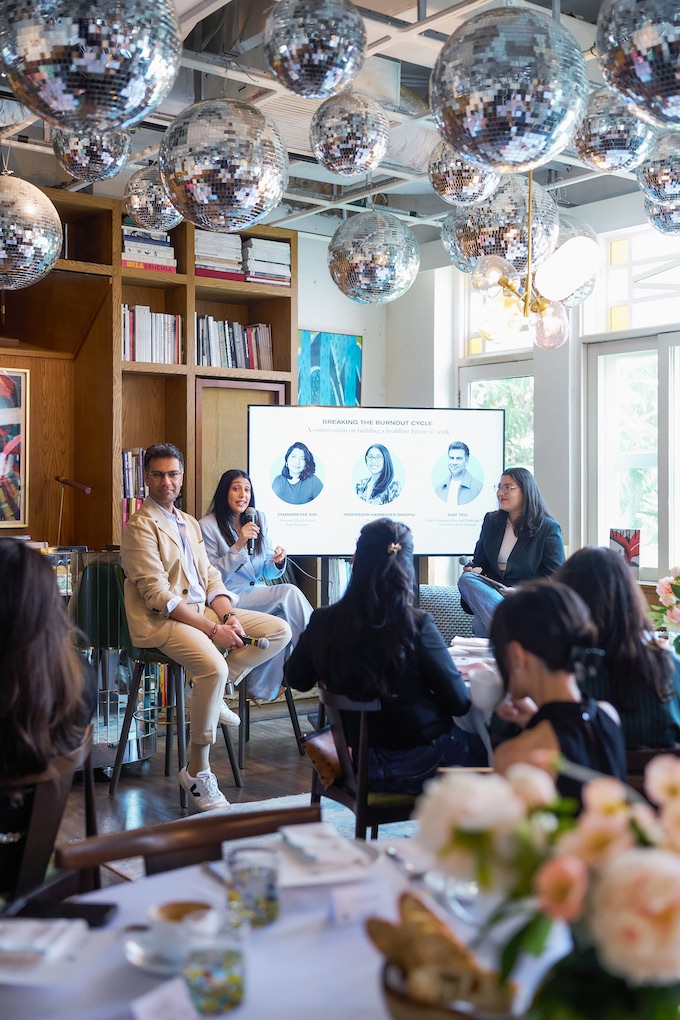
Moderated by Vogue Singapore’s associate lifestyle editor Chandreyee Ray, the panel featured two speakers from the University of Warwick who each bring a nuanced perspective on the subject: health psychologist and professor Harbinder Sandhu, and chief communications, marketing and content officer Ajay Teli. The conversation touched on various aspects regarding breaking the burnout cycle, one of which was the role of research in leading to meaningful change—something the University of Warwick has long been committed to driving through its world-leading research.
Hosted at the Mandala Club, in the disco-ball filled Analogue Room, an insightful conversation on combatting burnout on both a corporate and personal level unfolded. Ultimately, the speakers all agreed on one core point: as we witness the growing challenges of modern hustle culture, it’s more crucial now than ever to prioritise our well-being in a productivity-driven world, and to pursue a sustainable balance between performance and longevity. Here, see all the highlights from the panel.

What exactly is burnout?
In modern discourse, there is a harmful tendency to dismiss burnout as a fleeting mood. As a term that is rarely understood with real depth, the condition’s significant medical consequences are often overlooked.
“The WHO has recognised burnout as a syndrome in itself, which is linked to chronic stress in the workplace.” Sandhu explains, grounding the term in its scientific definition. “But research shows that it actually goes beyond stress. Furthermore, the ICD11 (International Classification of Diseases) has identified three states of burnout. First, you may experience exhaustion, which goes beyond just the workplace. Next is dissociation—feeling negative sentiments towards work you might normally find engaging. Lastly, you may find yourself being less efficient at work. These three things are a good starting point to understanding what is burnout.”

How does the modern work environment perpetuate burnout?
“Who is never not on all the time?” Teli poses hypothetically, as the room nods in unison. With the way our workplace culture has transformed in recent years, the ways in which we experience burnout has also evolved accordingly. “There is a lot of digital fatigue,” Teli adds, as he points out the digital constance around us.
“Psychological safety is about creating an environment where people feel comfortable being vulnerable”
In a similar vein, Teli introduces the concept of psychological safety, a crucial element in creating a healthy workplace. “As a leader, I think it’s really important to evaluate if your workplace is one where team members feel psychologically safe to say how they feel. If you don’t stop to take a breather, constant expectations to deliver can build up to a perpetual cycle. At what point do you then stop and go, ‘Am I experiencing burnout?'”
Creating a psychologically safe workplace
The question comes down to this: what does a psychologically safe workplace actually look like? “Psychological safety is essentially about creating an environment where people feel comfortable being vulnerable. For me, it’s really important to cultivate a workplace where people can thrive. But you can’t do that if the structures are not in place in the first place,” Teli explains.
“I want people to feel safe saying ‘I’ve got a lot going on,’ or ‘I’m struggling with this piece of work,’ or even ‘I’m taking on more and more and I don’t know what to do about it.’ You shouldn’t feel unsafe or judged for saying that—it is a problem if you do. As a leader, if you can help find a solution to that, essentially you’re collaborating with your team, and collaboration is the key.”

What are some physical manifestations of burnout?
Burnout is not just a feeling—there are real physical symptoms that manifest as a result. “From the physical side, we are talking high levels of cortisol in our body, and if that’s around for a long amount of time, it will soon start to take its toll,” Sandhu shares.
“Some of these symptoms might be: a lowered immune system, being more prone to chronic headaches or type 2 diabetes, or gastrointestinal problems. As you can see, there are many physical health conditions that can manifest as a result of burnout. One of the key reasons behind work absences is back pain, and back pain has been linked to chronic stress in the workplace. As I sometimes say to my patients, ‘when you’re stressed, you wear your shoulders as earrings.’ And that tension in the body is going to manifest from your neck into your back and all over the body.”
When burnout occurs, how can we deal with it?
“I would be very guilty if I said I have never experienced burnout,” Teli says, “We set expectations on ourselves to want to do more, and sometimes, you end up competing with yourself.” An important solution Teli employs is setting boundaries. “One example I’ve done is that I will not have meetings after 4:30pm. Because you need time to think. We all think we have enough time to get our work done, but how many of us are always in back-to-back meetings? When do we actually get the time to think?”


Sandhu reflects on her personal journey as a researcher: “I have just completed a 10-year clinical trial on opioid reduction, which involved a huge learning curve. At various points throughout the journey, I was close to burnout because I faced unforeseen challenges. Psychologically, understanding what’s in your control and focusing on those things is the first step.”
“I’m a real advocate for practical solutions, such as having a mentor. In the university, we’ve implemented a mentorship system with a goal of providing a safe space,” Sandhu adds. “My key practical solution is movement and exercise. I don’t mean necessarily going to the gym and lifting heavy weights, but just movement—anything from doing ten minutes in the morning to going to a class and doing pilates or yoga. Physical energy needs to be shifted, and there is a mind-body link that we have to be aware of. I have also found that when I’m more hydrated throughout the day, I’m more switched on, and I’m making better decisions.”

As individuals and businesses, how can we prioritise well-being in sustainable ways?
“There are three elements to think about,” Sandhu delineates, “capability, opportunity and motivation” which draws from a well-known behaviour change framework. “Firstly, do you as an individual—and your team—have the right skills and knowledge to manage your wellbeing? Secondly, does your workforce have the opportunity to engage in strategies to address stress and burnout? This includes putting on events, flexible working policies and wellbeing initiatives. And lastly—what is your motivation behind doing this?”
“One important tip is to look at research, take what is clinically addressed and then learn how to apply it,” adds Teli, shedding light on the University of Warwick’s commitment to driving positive impact through its world-leading research. “The university has the expertise, influence and platforms to reshape outdated workplace norms and create healthier, high-performing cultures. We do this through a range of initiatives, like partnering with businesses to test real-world workplace interventions, hosting roundtables, and offering executive education to drive change.”
He concludes: “The key lies in bridging research and real-world action. Professor Sandhu is a prime example of our world class academics, who help us apply great research in to everyday practice—which is what I have done in my teams.”
Find out more about the University of Warwick.